Most ultramarathon documentaries are really aid station films. A drone shot of the start line. The runner jogging into an aid station, refilling bottles, jogging out. Repeat five times. A hug at the finish. Roll credits.
That's not a 100-mile race. That's the handful of places where a crew can park a car and set up a camera. Everything that makes a 100 worth watching happens out on the course, between those aid stations: the ridgeline at sunrise, mile 62 in the dark, the long climb where the plan falls apart and a new one gets made.
That's where we film. We're on the course with the athlete, mile after mile, capturing the raw beauty of an ultramarathon: the terrain, the light, the silence, and the person moving through all of it.
We've filmed and edited race films for Willapa 100, Yeti 100 and Coldwater 100, shot Badger Mountain 100, and made films for three different athletes at Black Barn 200. We've also run these races ourselves. Here's how we film a 100-mile race so the footage actually tells the story.
"You can't film a 100-mile race from the finish line. You have to be inside it."
Plan the Race Before the Race
A 100 is 20 to 30-plus hours of footage you can't reshoot. The planning is what decides whether you get the story or just get tired.
- Study the course map and crew access. Know every aid station, which ones allow crew, and how long the drive is between them. Some crew points are 10 minutes apart by car. Some are two hours.
- Get the athlete's plan. Their goal splits, their nutrition plan, where they expect to hit each aid station. Then plan for them to be off it, because they will be.
- Mark sunset and sunrise. Know which sections the runner hits at golden hour and which ones happen at 3am. Those are two completely different shoots.
- Find the low point before it happens. Every course has a section where runners break: the long climb after mile 60, the exposed stretch in the heat, the second night. That's where the story is. Be there.
- Read the race rules. Where pacers can start, whether pacers can carry anything for the runner, where crew is allowed. Getting your athlete disqualified for a shot is not a film.
Pace It, Don't Chase It
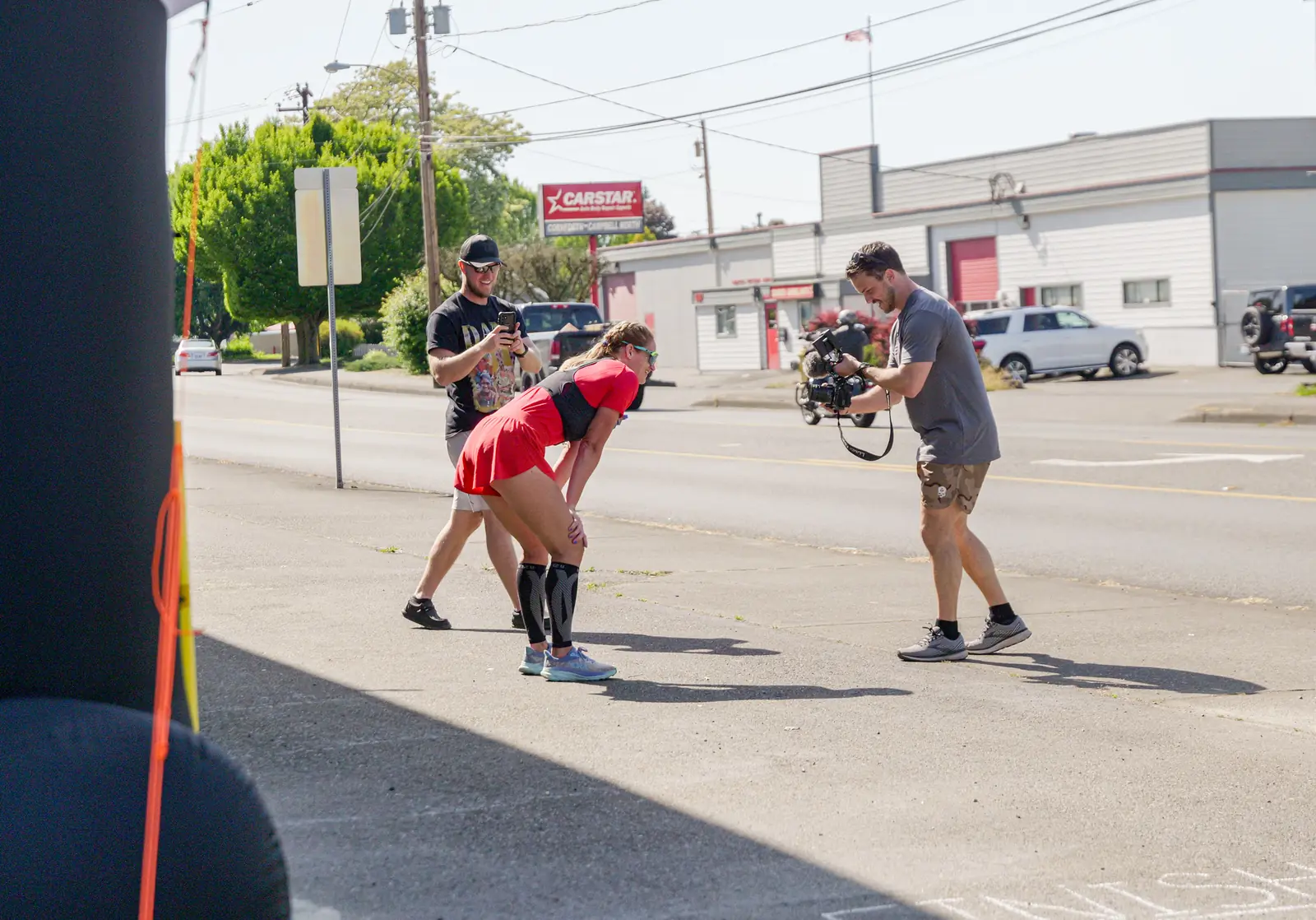
This is the biggest difference between how we film and how most crews do it. When we cover an athlete, we're usually their pacer too. We help crew, or we run the entire crew if they don't have one. The camera is running the whole time.
Being the pacer changes everything about the footage. You're not a stranger with a lens. You're the person who's been with them for 30 miles, so they talk to you. You see the moment they decide not to quit. You're there when the headlamp is the only light for miles. A camera crew leapfrogging aid stations never sees any of that.
The rule is simple: the race comes first. You never slow your runner down for a shot, you never ask for a retake, and you know when to put the camera away and just be a pacer. Some of the best moments in our films exist because we didn't push the camera into the moment before it.
Gear for 30 Hours on Course
You're carrying a camera for a distance most people don't drive in a day. Every gram matters, and so does anything that slows you down.
- Two kits, not one. A small, one-handed setup for running sections, and a bigger camera that lives in the crew vehicle for aid stations, the start and the finish.
- Batteries and cards for days. Cold drains batteries fast overnight. Keep spares in an inside pocket against your body, and offload cards at crew stops so a single failure can't cost you the race.
- Plan for the dark. Night footage is the hardest to get and the most valuable to have. Use the runner's headlamp as your light where you can. Never blast a light in a runner's eyes at 2am.
- Get the audio. Breathing, footsteps, the aid station volunteer asking what they need. Sound is half of what makes a race film feel real.
Shoot the Arc, Not the Course
Nobody watches a 100-mile film to learn the course. They watch it to see what happens to a person over 100 miles. So shoot for the arc:
- Never ask how they're feeling. At mile 70, the honest answer is almost always "awful," and asking makes the runner stop and think about it. Our job is to keep them out of their own head. Talk about anything else, keep them moving, and let the footage show what they're going through.
- Capture the crew. The person mixing bottles at 4am, the spouse holding a jacket, the kid at the aid station. That's where the emotion is.
- Get the small stuff. Taped feet, a half-eaten quesadilla, the watch showing 22 hours. Detail shots are what make runners say "that's exactly what it's like."
- Don't stop at the finish. The minutes after the finish, sitting in a chair and staring at nothing, are often better than the finish line itself.
One Race, A Season of Content
For athletes and brands, a 100-mile film is just the start. The same footage becomes a full film, short cuts for Instagram and TikTok, and ad creative that shows the product being used when it actually matters.
That's why we film races the way we do. If a nutrition brand's product shows up at mile 70 in a real race, that clip will outperform any studio shoot. If a race director has footage of their course at sunrise, that's next year's registration campaign. (We wrote about that in how to increase registrations for an ultra race.)
Filming a 100 well is hard. You have to be fit enough to pace, organized enough to crew, and disciplined enough to keep shooting at hour 25. It's also some of the most rewarding work we do, because the people who watch it know exactly what they're looking at.
Want your race, athlete or product filmed from inside the race? See how we work as an ultra running marketing agency, or send us a message →